Horace's Haul - even longer service!
Sergeant Horace William Stockham BEM South Staffordshire Regiment
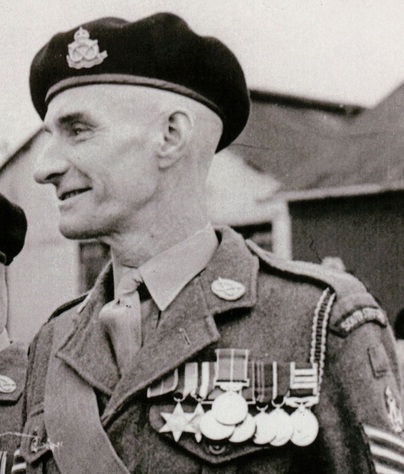
Horace William Stockham
The Man Horace William Stockham was born between April and June 1900 in the Municipal Borough of Burchills, Walsall in Staffordshire. Son of Frederick, a Brushmaker and Clara, Horace was one of four children. His siblings being Frederick, Leonora and Lilian and they lived at 47 Holly Lodge Lane. Nothing is known of his early life, but Horace did attest as a boy into the 5th Battalion, South Staffordshire Regiment Territorial Force (TF) on 29th May 1914 aged just 14, serving at their Headquarters in Whittimere Street, Walsall. He remained in the United Kingdom during the First World War and as such was not entitled to any awards. Following the Armistice he was stood down from the TF, but re-enlisted again shortly after and by 1927 had been promoted to Corporal in the same Battalion; his service number was 4906386. During 1921 the TF was elevated to the Territorial Army (TA) and Horace was awarded the Territorial Efficiency Medal in Army Order 378 of 25th November 1927 for 12 years service in the TF/TA. 12 years later in Army Order 27 of 28th February 1939 and by now a Private! He was awarded the Efficiency Medal ‘Territorial’ for a further 12 years service, the medal also having changed following a standardisation of reserve awards in 1930.
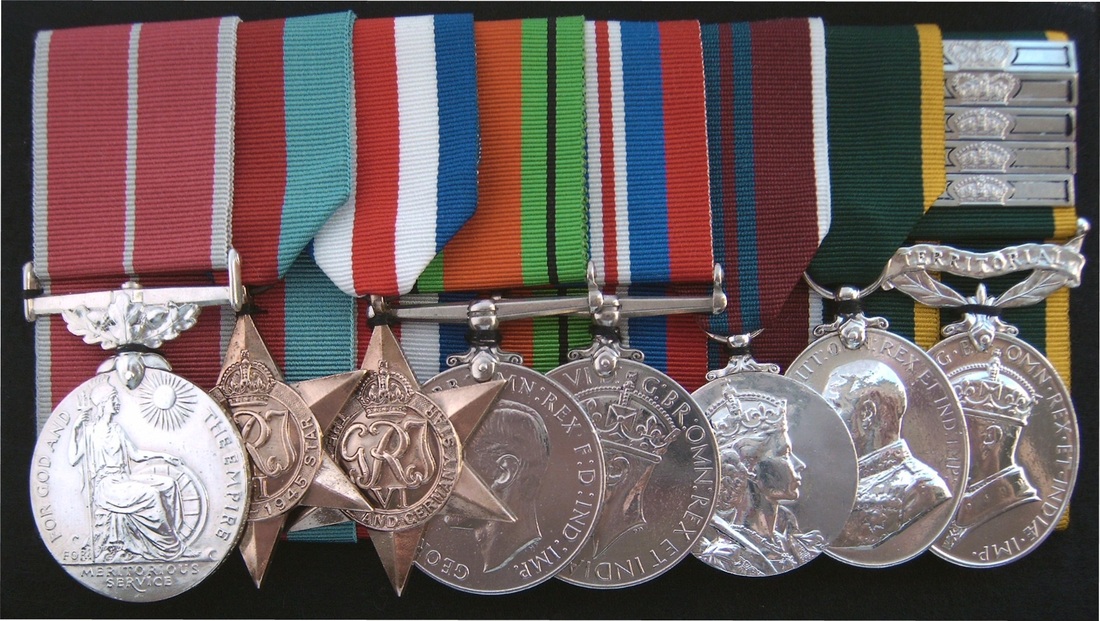
British Empire Medal (military). 1939-45 Star. France & Germany Star. Defence Medal. War Medal 1939-45. Coronation Medal 1953.
Territorial Efficiency Medal. Efficiency Medal 'Territorial' & five bars.
Horace was mobilised at the start of World War 2 aged 39, but little is known of his specific war service, except that in 1941 he transferred to the Royal Military Police. At the conclusion of the conflict he was awarded the 1939-1945 and France & Germany Stars, Defence & 1939-1945 British War Medals and in 1946 was de-mobilised again. He re-enlisted in 1947 still-with the 5th Battalion South Staffordshire Regiment and with the same service number. During these later years he became a prominent member of the Battalion’s Band, which instrument he played is unknown. In Army Order 45, list 14 of March 1950 he was awarded the first, second and third clasps to his Efficiency Medal, representing a further 18 years with the TA, although his war service did count as double time towards them, he was still shown as a Private at this time. During 1953 he was awarded Her Majesty’s Coronation Medal and by now promoted to the rank of Sergeant. In Her Majesty’s Birthday Honours list of 1954, Horace Was awarded the British Empire Medal (Military) which was announced in the London Gazette of 10th June, it was presented -
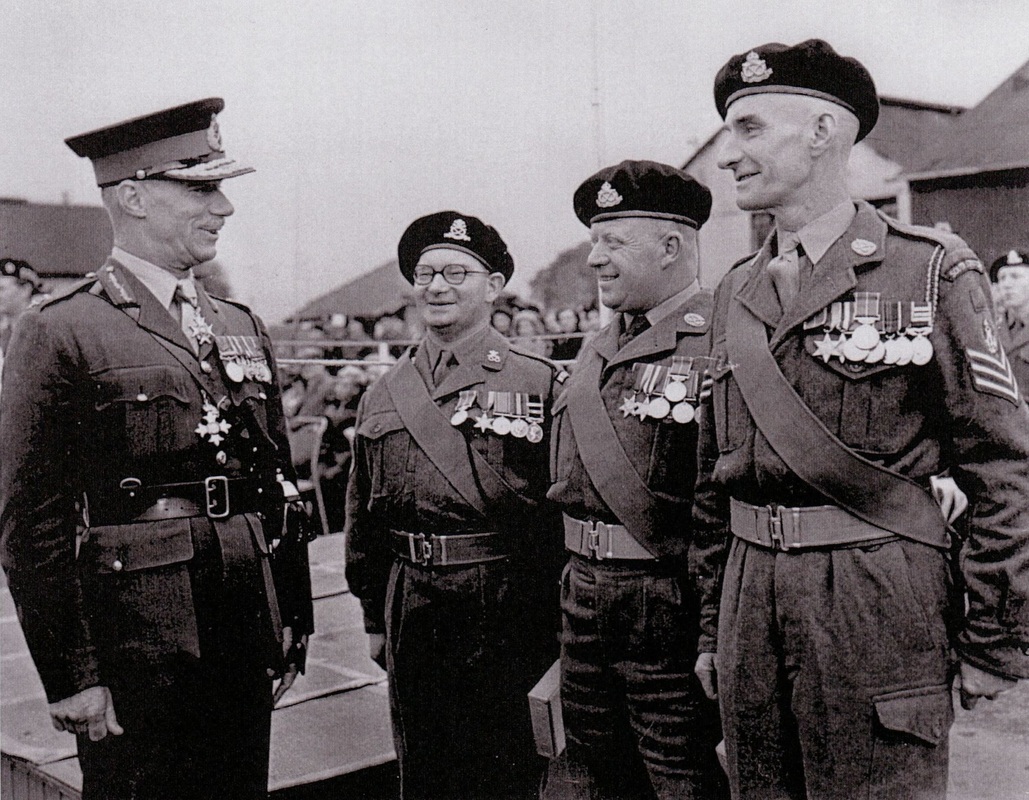
Presentation of the British Empire Medal on 13t October 1954 at Whittington Barracks, Lichfield, by Major General E M Bastyan CB CBE
to Sgt R G C Cooper, Drum Major S Crooke and Sgt H W Stockham.
-formally to him during a ceremony at Whittington Barracks, Lichfield, by Major General E M Bastyan CB CBE. In Army Order 70, List 52 of October 1961 he was awarded a fourth and fifth clasp to his Efficiency Medal, adding another 12 years service, totalling 54 years in the Territorial Army. These were presented to him by the Battalion’s Honorary Colonel, Colonel G B Grey CBE TD ADC DL at a parade in February 1963 at Sennybridge. By August 1964 Horace, now aged 64 was still serving in the Battalion’s band and following an enquiry in The Territorial Magazine and the Journal of the Staffordshire Regiment, The Staffordshire Knot, of the same month by the Commanding Officer, Lieutenant Colonel H H L Cartwight, it was confirmed in March 1965 that Horace was the longest serving Territorial in the country at that time having completed over 50 years. During the Battalion’s Annual Camp in August 1964 at Devizes, Horace’s Service was recognised when on Saturday 15th August he was commended to the Battalion by their Honorary Colonel and joined him on the saluting dais for the march past at the conclusion of the Parade. Horace stated that he proposed he would only fall out when (and if!) ordered to by Oi/c Records. He retired aged 65 and was presented with an inscribed cigarette case. Horace died at Walsall General Hospital on 16th August 1973, aged 73 and had the distinction of being one of the, if not the longest serving member of the Territorial Army from 1914–1965.
|
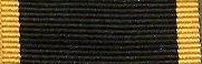
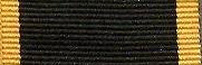
The Story This group of ‘very’ long service medals representing 54 years service within the Territorial Army and in both world wars, first came to the attention of the author in late 1994. It was following the acquisition at the Orders & Medals Research Society annual convention the same year of two groups of medals, one to Sergeant Charles Tanner, the other to Sergeant Robert Venn. Both these sets contained a Territorial Efficiency Medal and an Efficiency Medal, having the unusual distinction of two identical ribbons, green with a narrow yellow stripe either side, mounted next to each other within the same group. The author was trying to establish whether a precedent had ever been set for this and a few months later, by coincidence, John Tamplin’s book The Territorial Force Efficiency Medal 1908-1921 was purchased and within, on page 27 was a photograph of Horace Stockham wearing a similar combination of medals with the same two identical ribbons next to each other, Territorial Efficiency and Efficiency Medals – thus the precedent had been set! 15 years later in March 2009, a colleague of the author’s from the Birmingham Medal Society sent him a spare copy of the Dix Noonan & Webb auction catalogue for an auction to be held on Thursday 26th March 2009 that included Long Service Medals from the Collection formed by John Tamplin (Part III). Whilst browsing the catalogue there appeared the distinctive photograph of Horace Stockham that had been seen in Tamplin’s publication some years before and for auction, his medals as detailed in the book!
|
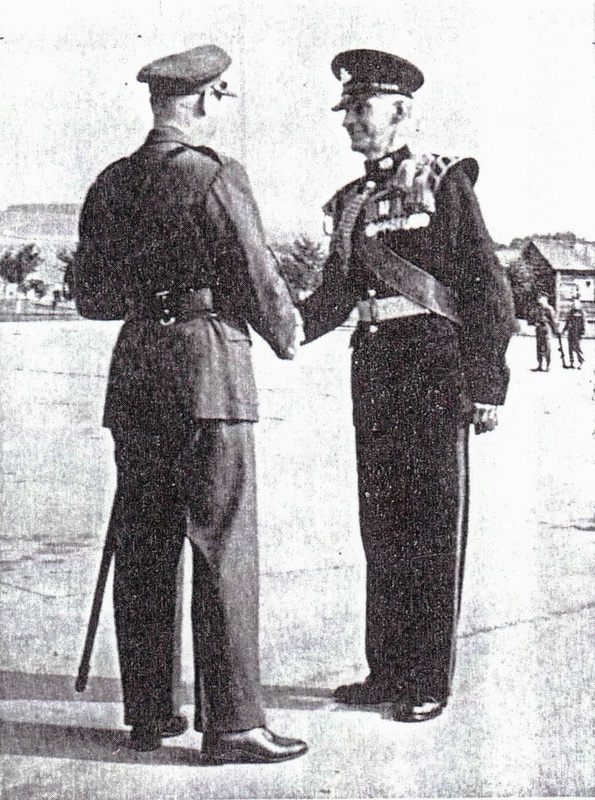
Sgt H W Stockham being congratulated by the Honorary Colonel during the Battalion’s Ceremonial Parade at Devizes.
Saturday 15th August 1964
|
Naturally this was too good an opportunity to miss and a bid was placed on the group which were duly won. By coincidence the author was in London a few days later and they were paid for and collected in person from DNW on 30th March 2009. Contained within the lot was substantial information on the military career of Horace, but not very much on his civilian life. A search for a will proved negative but Ancestry.com enabled a little further detail to be added from the census of 1901 and direct contact from a member of the family who had started a family tree. Piecing everything together allowed the above brief biography to be compiled and shows what a tight knit community medal collecting can be, as the same group can re-appear some years later in the most unexpected and coincidental set of circumstances and places. A visit to the relatives is to be arranged and hopefully additional information on his civilian life will become available.
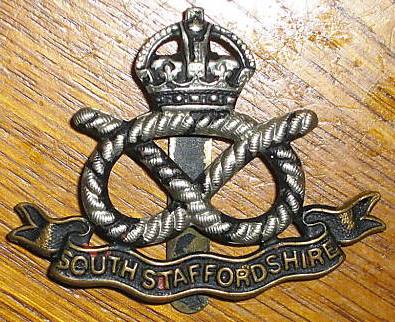
South Staffordshire Regiment Cap Badge
|
The South Staffordshire Regiment
Was an infantry regiment of the British Army formed in 1881, but with antecedents dating from 1705. In 1959 the regment was amalgamated with the North Staffordshire Regiment to form the Staffordshire (Prince of Wales’s). The lineage of the South Staffords is continued by the Mercian Regiment. Formation and antecedents The regiment was formed as part of the Childers Reforms on July 1, 1881 by the amalgamation of the 38th and 80th regiments of foot, which became the regular 1st and 2nd Battalions of the regiment. Militia and Rifle Volunteers of south Staffordshire were also incorporated in the new regiment. The battalions formed in 1881 were as follows: 1st Battalion: the 38th (1st Staffordshire) Regiment of Foot, raised in Lichfield in 1705 as Colonel Luke Lillingstone's Regiment, numbered as the 38th in 1751, and received the subsidiary title of 1st Staffordshire in 1782. 2nd Battalion: the 80th (Staffordshire Volunteers) Regiment of Foot, raised in 1793 by Lord William Henry Paget from members of the Staffordshire Militia. 3rd (Militia) Battalion: 1st Battalion (The King's Own) 1st Staffordshire Militia 4th (Militia) Battalion: 2nd Battlalion - |
- (The King's Own) 1st Staffordshire Militia 1st Volunteer Battalion: 1st Staffordshire Rifle Volunteer Corps 3. 2nd Volunteer Battalion: 3rd Staffordshire Rifle Volunteer Corps 3rd Volunteer Battalion: 4th Staffordshire Rifle Volunteer Corps. The reserve battalions of the regiment were re-organised in 1908 by the Territorial and Reserve Forces Act 1907, with the two militia battalions as the 3rd and 4th (Special Reserve) Battalions and the 2nd and 3rd Volunteer Battalions transferring to the Territorial Force as the 5th and 6th Battalions (TF). The 1st Volunteer Battalion became 1st North Midland Field Company, RE and ceased to be part of the regiment. 1881 – 1914 The 1st Battalion (the former 38th) was sent to Egypt in 1882 as part of the British invasion of the country. On landing in Alexandria they carried their colours through the city. This was the last occasion on which a British Army unit carried their colours on active service. In 1885 they travelled up the River Nile to Sudan in an unsuccessful attempt to lift the Siege of Khartoum. The battalion was subsequently involved in the defeat of Arab forces at Kirbekan. The battle was to be the last time that the South Staffords wore red uniforms in battle. The 1st Battalion then entered a long period of garrison duty in Gibraltar, Egypt, England and Ireland. With the outbreak of the Second Boer War they embarked for South Africa, arriving as part of the 8th Division in 1900. The battalion was mostly involved in minor skirmishes with the Boers, but suffered casualties due to disease and poor nutrition. In 1904 the 1st South Staffords returned to the UK, being stationed in Ireland and England until 1911, when they moved to Gibraltar. While in Gibraltar, new colours were presented to the battalion by King George V on January 31, 1912. The battalion returned to South Africa in 1913. The 2nd Battalion (the former 80th) was stationed in India in 1881, soon moving to Tralee in Ireland, where they were involved in actions against Irish nationalists. They returned to England in 1883, were posted to The Curragh from 1889 to 1891, before travelling to Egypt via Aldershot in 1893. They subsequently served in southern India and Burma until 1907, when they started a four-year posting in Pretoria, South Africa. The battalion returned to England in 1911. Battle Honours: By 1914, the regimental colours displayed the following battle honours, representing the actions of the 38th and 80th Foot to 1881, and the South Staffordshire Regiment after that date.
- Guadeloupe 1759 (awarded 1909)
- Martinique 1762 (awarded 1909)
- Rolica (awarded 1831 to 38th Foot)
- Vimiera (awarded 1821 to 38th Foot)
- Corunna (awarded 1831 to 38th Foot)
- Busaco (awarded 1831 to 38th Foot)
- Badajos (awarded 1831 to 38th Foot)
- Salamanca (awarded 1817 to 38th Foot)
- Vittoria (awarded 1831 to 38th Foot)
- St Sebastian (awarded 1817 to 38th Foot)
- Nive (awarded 1831 to 38th Foot)
- Peninsula (awarded 1815 to 38th Foot)
- Ava (awarded 1826 to 38th Foot)
- Moodkee (awarded 1847 to 80th Foot)
- Ferozeshah (awarded 1847 to 80th Foot)
- Sobraon (awarded 1849 to 80th Foot)
- Pegu (awarded 1853 to 80th Foot)
- Alma (awarded 1855 to 38th Foot)
- Inkerman (awarded 1855 to 38th Foot)
- Sevastopol (awarded 1855 to 38th Foot)
- Lucknow (awarded 1863 to 38th Foot)
- Central India (awarded 1863 to 80th Foot)
- South Africa 1878-79 (awarded 1882)
- Egypt 1882
- Kirbekan
- Nile 1884-85
- South Africa 1900-02
- Mons
- Marne, 1914
- Aisne, 1914, '18
- Ypres, 1914, '17
- Loos
- Somme, 1916, '18
- Cambrai, 1917, '18
- St Quentin Canal
- Vittorio Veneto
- Suvla
- Caen
- Noyers
- Falaise
- Arnhem 1944
- North-West Europe 1940, '44
- North Africa 1940
- Landing in Sicily
- Sicily, 1943
- Chindits 1944
- Burma, 1944
Medal Details:
- British Empire Medal: 4906386 SGT. HORACE.W.STOCKHAM. S.STAFFORDS. T.A.
- 1939-45 Star: Unnamed as awarded.
- France & Germany Star: Unnamed as awarded.
- Defence Medal: Unnamed as awarded.
- War Medal 1939-45: Unnamed as awarded.
- Coronation Medal 1953: Unnamed as awarded.
- Territorial Efficiency Medal: 4906386 CPL. H.STOCKHAM. 5-S.STAFF.R.
- Efficiency Medal: 4906386 CPL. H.STOCKHAM. 5-S.STAFF.R.
Return to: The Collection
Go to Previous Page: Alexander Wilson STENHOUSE
Go next Page: Thomas Edward STOCKLEY
Go to Previous Page: Alexander Wilson STENHOUSE
Go next Page: Thomas Edward STOCKLEY
This page last updated 15 Sep 15
