Whitewood's Wars
Warrant Officer Class 2 Frederick Whitewood Royal Artillery
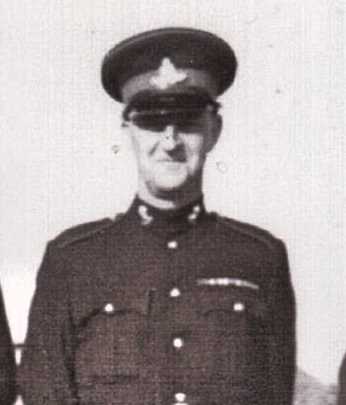 Frederick Whitewood
The Man Little detail is known about Frederick Whitewood’s early life except that he was born on 20th November 1919 on the Isle of Wight, his mother possibly being unmarried as she had the same maiden name. He enlisted into the Territorial Army, Royal Engineers on 18th June 1936, with service number 2036761 and qualified as a Fitter AII on 26th April 1938. He was called out on 26th September 1938, again on 18th June 1939 and finally on 24th August 1939 at East Cowes, just over a week before the outbreak of World War II. He was described as 5’ 11¾ tall with a fresh complexion, brown eyes, dark hair and a blood group of A positive. Frederick was a Fitter by trade and may have been within a reserved occupation as he saw no service between 25th September - 25th November 1939, and again between 1st January 1940 - 5th January 1944, when he was re-embodied. On 16th March he transferred to the Royal Artillery as a Gunner with the same number and qualifying as a Fitter Gunner CIII on 27th April. He served in the UK until 3rd October 1944 and then posted to North West Europe in the 20th Anti-Tank Regiment which consisted of four Batteries operating M-10 tank destroyers and 6 pounder guns. The unit landed on D-Day with the 3rd Division and served in Normandy, Belgium and Holland. He returned home on 18th June 1945 before returning to NW Europe on 10th July where he remained until 23rd October when posted to the Middle East in Palestine where he served in theatre between December 1945 and April 1946 as a Bombardier still in the 20th Anti Tank Regiment in the 3rd British Infantry Division. For his war service and time in Palestine Frederick was awarded the 1939-45 Star, France & Germany Star, War Medal 1939-45, General Service Medal with clasp ‘Palestine 1945-48’ and Efficiency Medal ‘Territorial’, although the latter was not awarded until 31st May 1961. He did not qualify for the Defence Medal, but may have earned this within his reserved occupation capacity or a Civil Defence organisation between January 1940 and 44.
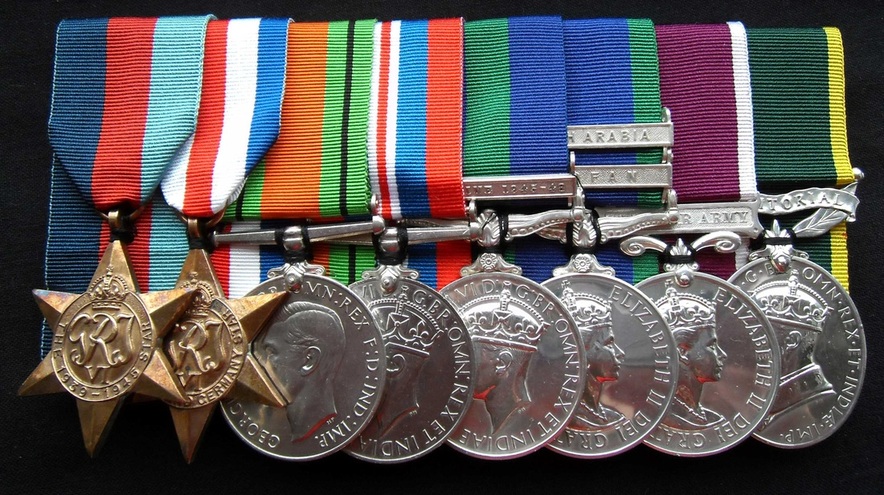
1939-45 Star. France & Germany Star. Defence Medal. War Medal 1939-45. General Service Medal 'Palestine 1945-48'. Campaign Service Medal 'Radfan' South Arabia'.
Army Long Service & Good Conduct Medal. Efficiency Medal 'Territorial'.
Frederick transferred to the Regular Army in the RA with the same number and during the third quarter of 1948 married Kathleen Ruby Downer on the Isle of Wight. He gained an Army Certificate of Education 2nd Class on 13th November 1950 and First Class in March 1954. He served in Germany with the British Army on the Rhine from 6th May 1953 until 7th February 1957, then in the UK until 11th Aprill 1962 before returning to the BAOR on 12th April. Fredrick was promoted to Warrant Officer Class 2 and awarded the Army Long Service & Good Conduct medal in about 1965. He saw service in Aden during 1964 fighting against the Radfan Tribesmen and then in South Arabia between 14th April 1965 and 19th October 1966 against the terrorists trying to eject the British and awarded the Campaign Service Medal with clasps ‘Radfan’ and ‘South Arabia’. The Radfan clasp being quite scarce to the RA as the only formed units present were ‘J’ Battery 3rd Royal Horse Artillery and a section of 5.5” guns from 170 Battery, 45 Field Regiment RA. Frederick finally retired from the Army on 4th January 1971 aged 51 at Beaconsfield under Paragraph 503 of the queen’s Regulations 1961, having served a total of 27 years and 71 days service plus the 4 years and 63 days spent on reserve, within his reserved occupation. He was awarded a pension and certificate of good service. On his retirement his Commanding Officer said of Frederick “A Warrant Office of high supervisory and organising ability. He has a marked sense of responsibility and loyalty. He is sober, honest, cheerful in adversity and is a hard worker. He gets on well with people and is not afraid to express an opinion. A man who has given outstanding service to the Army and he will do well for any employer”. His assessment of proficiency read “A very capable Warrant Officer I/C unit accommodation stores. He knows the Barracks side of stores and has performed a job in the B/A category during emergency. Needs no supervision”. Frederick died on 1st June 1985, aged 65 and was living at 29 Fairlea Road, Newport still on the Isle of Wight. Kathleen survived him by 20 years and died on 11th July 2005.
The Story The group of medals awarded to Frederick Whitewood were seen in Norman W Collett’s catalogue in October 2014 and acquired almost immediately. They were of interest because of the unusual combination, both the Efficiency Medal and Regular Army long service medal, indicating he had joined the regular Army after his TA service, plus the General and Campaign Service Medals with three clasps in total, all with the same service number and all on top of World War II service. An interesting and rarely seen combination. Unfortunately not a lot of extra detail could be located from ancestry.com, thus only a very basic biography has been possible. Sadly Frederick’s General Service Medal is an official replacement, and the original may well be ‘out there somewhere’! In December 2014, Norman Collett made contact, as he had located some original paperwork and a photograph of Frederick, this enabled a little more detail to be added to the biography.
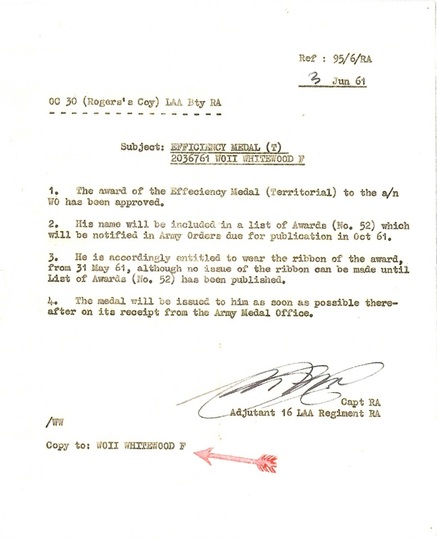
Letter confirming the award of the Efficiency Medal in 1961.
|
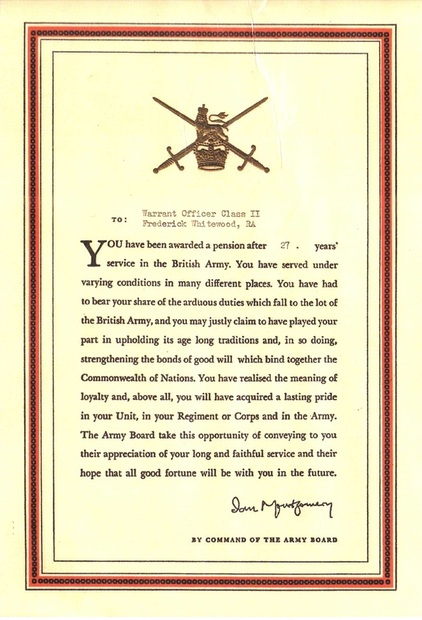
Army Certificate of Service
|
However, as is often the case, the paperwork raised more questions than it answered! Why was Frederick not awarded the Defence Medal, how was his Army Service and Reserve service calculated and why was is Efficiency Medal not awarded until 1961. Whilst no definitive answer has been found the following is a likely explanation.
1. Based on his Army service he is not entitled to the Defence Medal. However he had sufficient time to have earned it as a civilian, and it is likely that as a Fitter he was in a reserved occupation and served in one of the Civil Defence organisations qualifying through them.
2.He has two breaks in service once the war has started. The first was from 26 Sept 39 to 24 Nov 39 (60 days) and from 2 Jan 40 to 4 Jan 44 (4 years 3 days). This is the Reserve time of 4 years 63 days. Furthermore the Efficiency Medal regulations state that a member who is released for the purpose of work of national importance and if he is recalled for military service before his disembodiment, this period will count as single time (Army Order 55 of April 1943), again linked to a Reserved Occupation.
3. The Army Service time starts from when he was mobilized on the 24 August 39. There are 3 periods, from 24 Aug 39 to 25 Sept 39 (33 days), from 25 Nov 39 to 1 Jan 40 (38) and from 5 Jan 44 to 4 Jan 71 (27 years). The total time for the 3 periods is 27 years 71 days. It is not known why his pre-war TA service is not counted in the calculations, but may have been overlooked which is why they are at the top of the page.
When he rejoined on 5 Jan 44 it would have been as a member of the TA and his regular service would not have started until after the war ended. If the Army was like the RAF, there were no regular commissions/enlistments after 3 Sep 39 until sometime after the war finished. It is possible that in 1961 Frederick was approaching his 18 year point (from 5 Jan 44) and checks were made on his actual service to see when he would be entitled for the Military LS&GC medal and found that he was due the Efficiency Medal as well.
It is also likely that the break in service in the autumn of 1939 was due to the Civilian authorities and the Army arguing who had the first call on his service. It looks like the civilians won.
1. Based on his Army service he is not entitled to the Defence Medal. However he had sufficient time to have earned it as a civilian, and it is likely that as a Fitter he was in a reserved occupation and served in one of the Civil Defence organisations qualifying through them.
2.He has two breaks in service once the war has started. The first was from 26 Sept 39 to 24 Nov 39 (60 days) and from 2 Jan 40 to 4 Jan 44 (4 years 3 days). This is the Reserve time of 4 years 63 days. Furthermore the Efficiency Medal regulations state that a member who is released for the purpose of work of national importance and if he is recalled for military service before his disembodiment, this period will count as single time (Army Order 55 of April 1943), again linked to a Reserved Occupation.
3. The Army Service time starts from when he was mobilized on the 24 August 39. There are 3 periods, from 24 Aug 39 to 25 Sept 39 (33 days), from 25 Nov 39 to 1 Jan 40 (38) and from 5 Jan 44 to 4 Jan 71 (27 years). The total time for the 3 periods is 27 years 71 days. It is not known why his pre-war TA service is not counted in the calculations, but may have been overlooked which is why they are at the top of the page.
When he rejoined on 5 Jan 44 it would have been as a member of the TA and his regular service would not have started until after the war ended. If the Army was like the RAF, there were no regular commissions/enlistments after 3 Sep 39 until sometime after the war finished. It is possible that in 1961 Frederick was approaching his 18 year point (from 5 Jan 44) and checks were made on his actual service to see when he would be entitled for the Military LS&GC medal and found that he was due the Efficiency Medal as well.
It is also likely that the break in service in the autumn of 1939 was due to the Civilian authorities and the Army arguing who had the first call on his service. It looks like the civilians won.
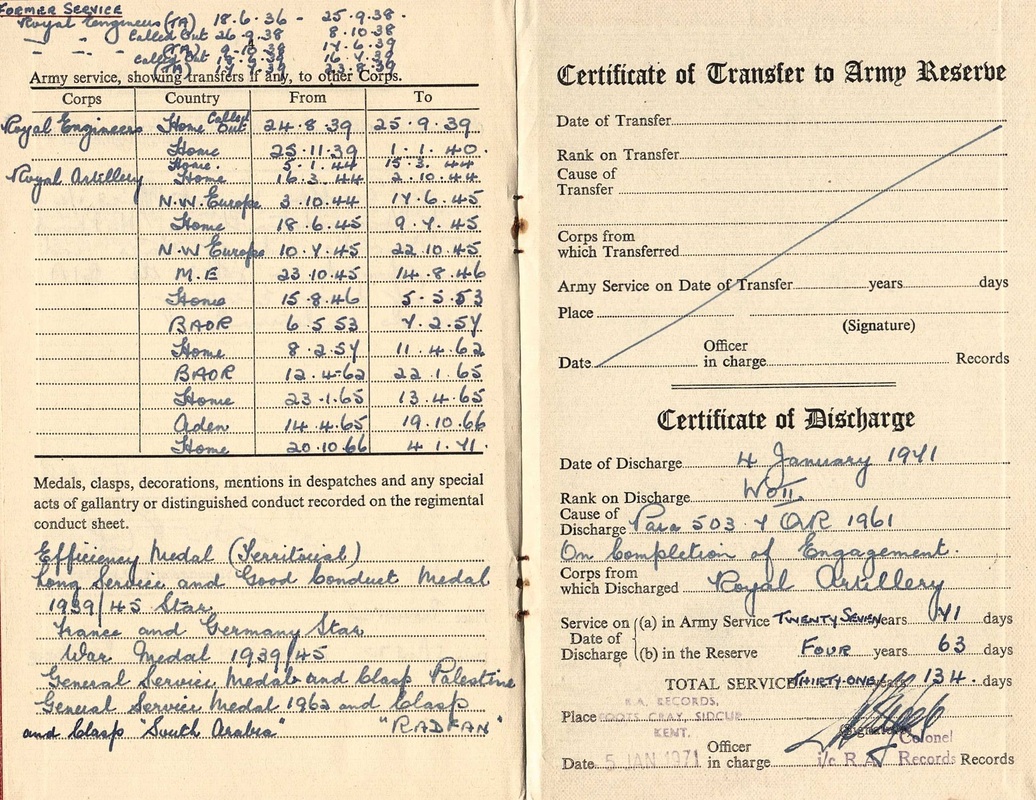
Frederick Whitewood's Army Certificate of Service confirming the award of his medals except the Defence Medal.
Medal Details
- 1939-45 Star: Unnamed as awarded.
- France & Germany Star: Unnamed as awarded.
- Defence Medal: Unnamed as awarded.
- War Medal 1939-45: Unnamed as awarded..
- General Service Medal: 2036761 GNR.F.WHITEWOOD. R.A. (REPLACEMENT)
- Campaign Service Medal: 2036761 W.O. CL.2. F.WHITEWOOD. R.A.
- Army Long Service Medal: 2036761 W.O. CL.2. F. WHITEWOOD. R.A.
- Efficiency Medal: 2036761 GNR F.WHITEWOOD. R.A.
Return to: The Collection
Go to Previous Page: William George WHITER
Go to Next Page: Edgar Audley WHITTAKER
Go to Previous Page: William George WHITER
Go to Next Page: Edgar Audley WHITTAKER
Page last updated 21 Mar 14
470
